
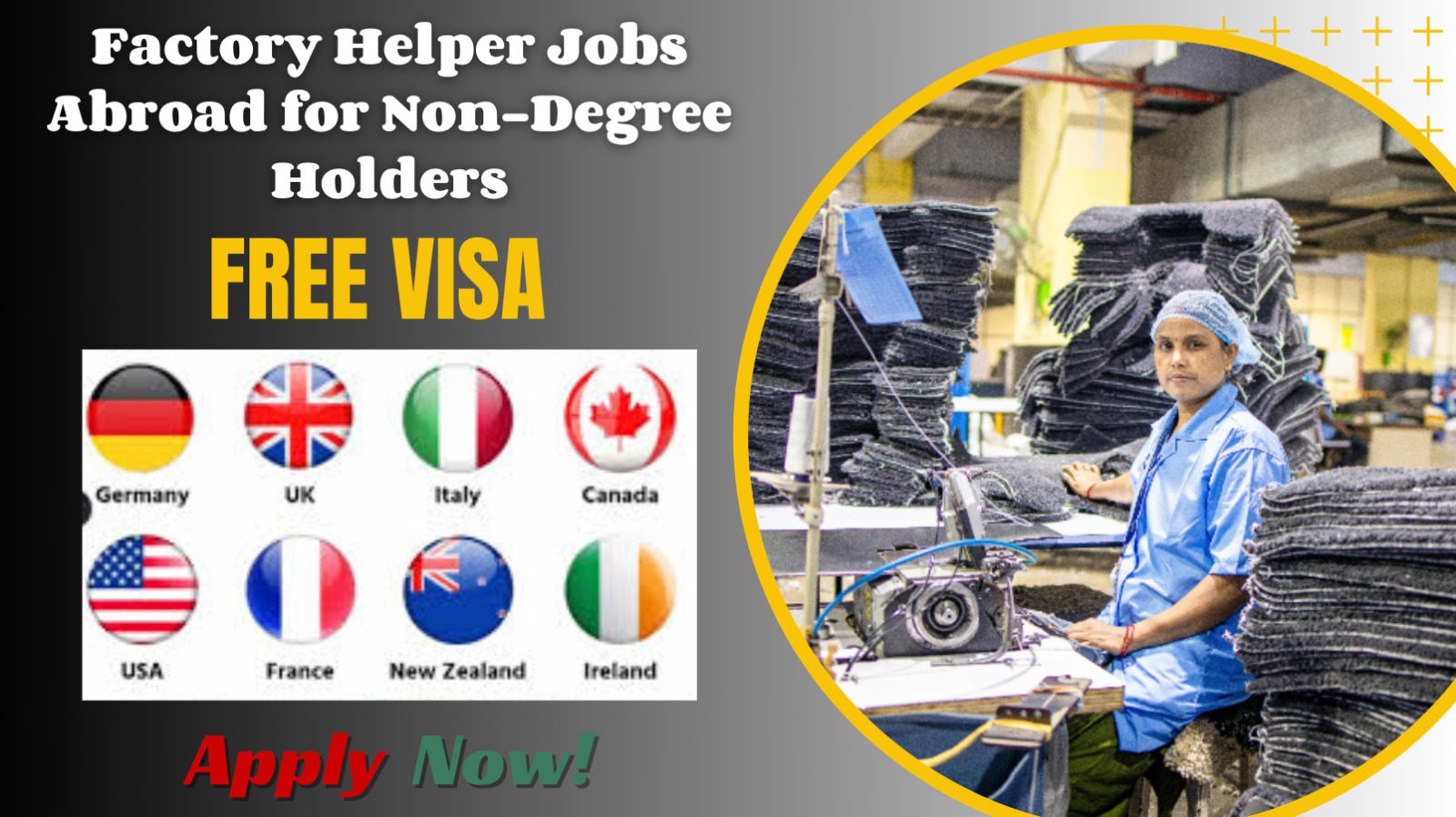
Factory Helper Jobs Abroad for Non-Degree Holders: Factory helper jobs are a practical entry point for non-degree holders seeking work abroad. These roles involve supporting production lines, handling materials, and maintaining factory areas. While formal education isn’t required, the key challenge is securing legal work authorization. This guide explains realistic pathways, in-demand sectors, and how to navigate the process successfully.
Understanding the Role and Demand
A factory helper (also called production assistant, general worker, or operative) performs essential support tasks in manufacturing plants. Key sectors include:
- Food Processing: Meat packing, beverage bottling, snack production.
- Automotive Parts: Assembly support, component handling.
- Electronics: Basic assembly, product testing, packaging.
- Textiles & Garments: Fabric handling, machine tending.
- Plastics & Packaging: Operating basic machinery, quality sorting.
The Reality of Work Authorization
There is no global “Factory Helper Visa.” Access depends entirely on the immigration rules of the destination country. For non-degree holders, options are limited but exist through specific programs.
Primary Legal Pathways:
1. Working Holiday Visa (WHV) – Best for Young Applicants
- What it is: An open work permit for young adults (18-30/35) from eligible countries.
- How it helps: Allows you to work legally in factories for 1-2 years without needing employer sponsorship first. Available in Australia, New Zealand, Canada, Japan, South Korea, and some European countries.
- Action: Check if your passport country has WHV agreements.
2. Seasonal/Temporary Work Programs
- How it works: Governments allow temporary foreign workers in specific industries facing labor shortages.
- Examples:
- Canada: Temporary Foreign Worker Program (TFWP) for food processing and manufacturing roles.
- Australia: Seasonal Worker Programme and Pacific Australia Labour Mobility (PALM) scheme, which includes meat processing and factory work.
- Eastern Europe: Some factories in countries like Poland, Romania, and Czechia hire non-EU helpers through work permit programs, often for citizens of neighboring Eastern Partnership countries.
- Process: You must be recruited from your home country through authorized agencies. You cannot travel first to look for these jobs.
3. Intra-Company Transfers (Not Applicable)
- For existing employees transferring within a company, not for new hires.
4. For EU Citizens
- Freedom of movement allows you to work in any EU/EFTA country. Your main task is finding the job.
Key Countries and Their Specific Systems
- Australia: Strong demand in food processing (meat, dairy). The TFWP and PALM schemes are primary routes. WHV allows initial entry and job search.
- Canada: Food processing (particularly in Alberta, Manitoba) and manufacturing (Ontario) use the TFWP. WHV is excellent for initial access.
- New Zealand: Similar to Australia, with RSE scheme and WHV options.
- Poland/Czechia: Manufacturing sectors often hire from Ukraine, Belarus, Moldova, and other Eastern countries through simplified work permit procedures.
- Germany: Very difficult for basic helper roles. Focuses on skilled workers (Fachkräfte) with recognized vocational training.
Essential Requirements for Success
- Legal Work Rights: Securing the appropriate visa is non-negotiable and must be your first step.
- Language Skills: Basic proficiency in the local language is critical for safety and integration. For English-speaking countries (AU, CA, NZ), a functional level of English is required. For Poland/Germany/Czechia, basic local language skills (A1/A2) are necessary.
- Physical Fitness & Reliability: The most valued traits for these roles are showing up on time and being able to perform repetitive physical tasks.
- Specific Certifications:
- Food Safety/Hygiene Certificate: Required for food processing jobs (often obtained after hiring).
- Forklift License: A huge advantage that can lead to better pay (can often be obtained locally).
- Basic Safety Certifications: Like a White Card for construction sites if working in related factories.
How to Find These Jobs: A Realistic Strategy
Step 1: Secure Your Legal Pathway
- If eligible, apply for a Working Holiday Visa. This gives you maximum flexibility.
- If not, research which countries have seasonal/temporary work programs for your nationality. Contact your national Ministry of Labor to understand official recruitment channels.
Step 2: Target the Right Locations
- Research industrial regions: Regional Australia (e.g., Shepparton, Griffith), Central Canada (e.g., Winnipeg, Calgary area), Eastern Poland (e.g., Lublin region).
Step 3: Effective Job Search Methods
- Industrial Recruitment Agencies: This is the most effective method. Register with agencies that supply workers to factories:
- Australia/New Zealand: Programmed, AWX, Kinetic, AWF.
- Canada: Randstad, Adecco, Manpower.
- Poland/Czechia: Local agencies like Manpower, Grafton, or Gremi Personal.
- Company Career Pages: Apply directly to large manufacturers (e.g., food processors like JBS, Saputo; automotive suppliers).
- Government Job Portals: Use official sites like Job Bank (Canada), Workforce Australia, Praca (Poland).
- Networking: Connect with your country’s community already working abroad.
What to Expect: Realistic Conditions
- Pay: Typically at or slightly above minimum wage. In Australia/Canada, expect 18-25 AUD/CAD per hour. In Poland/Czechia, expect 15-22 PLN/CZK per hour gross. Overtime can significantly increase earnings.
- Work: Repetitive tasks, shift work (nights, weekends common), physically demanding environment.
- Accommodation: In remote locations, employers may provide (and deduct cost for) shared housing. In cities, you’ll need to find your own.
- Contracts: Temporary or fixed-term contracts are common. Ensure you understand your rights.
Important Warnings
- Avoid Scams: Never pay money for a “guaranteed job” or “visa sponsorship.” Legitimate programs do not charge workers large fees.
- Legal Work Only: Working without a proper visa (“on the black”) leaves you vulnerable to exploitation, non-payment, and deportation.
- Health & Safety: Factory work has risks. Ensure you receive proper safety training. Do not operate machinery you’re not trained on.
Final Summary
Factory Helper Jobs Abroad for Non-Degree Holders: Factory helper jobs abroad are accessible for non-degree holders through specific legal channels, not through random overseas applications.
Your actionable plan:
- First, secure legal work rights via a Working Holiday Visa or an official seasonal work program through your government.
- Learn basic language skills for your target country.
- Register with industrial recruitment agencies immediately upon arrival or during the application process.
- Target regions with high manufacturing activity.
Begin by:
- Checking your eligibility for a Working Holiday Visa.
- Contacting your national employment authority to ask about overseas work programs for factory/processing jobs.
- Researching the largest food processors and manufacturers in your target countries.
Success requires patience, using official channels, and being prepared for physically demanding work. The opportunity is real, but it must be approached through the proper legal and practical steps.
Disclaimer
This job information is shared for educational and informational purposes only.
Any discussion of visa categories is based on general immigration laws and publicly available information.